some latest papers:
-
W.Quapp: J. Molec. Struct. 695-696 (2004) 95-101
"How Does a Reaction Path Branching Take Place?
A Classification of Bifurcation Events"
Reprint im PDF Format: download
-
W.Quapp, M.Hirsch, D.Heidrich:
Theor. Chem. Acc. 112,No.1 (2004) 40-51
"An Approach to Reaction Path Branching using
Valley-Ridge-Inflection Points of Potential Energy Surfaces "
-
W.Quapp: Journal Computat Chemistry
25 No.10 (2004) 1277-1285
"Reaction Pathways and Projection Operators:
Application to String Methods"
-
M.Hirsch, W.Quapp:
J Math Chem 36 No 4 (2004) 307-340
"Reaction Pathways and Convexity of the Potential Energy
Surface: Application of Newton Trajectories"
-
M.Hirsch, W.Quapp:
J.Mol.Struct. THEOCHEM 683 No.1-3 (2004) 1-13
"Reaction Channels of the Potential Energy Surface:
Application of Newton Trajectories"
-
W.Quapp: Theoret. Chem. Account, 121 No.5-6 (2008) 227-237
"Chemical Reaction Paths and Calculus of Variations "
W.Quapp: J.Theoret.Comput.Chem. 8, Iss.1 (2009) 101-117
"The growing string method for flows of Newton trajectories by a second order corrector"
-
W.Quapp, A.Zech: J.Comput.Chem. 31, Iss.3 (2010) 573-585
"Transition State Theory with Tsallis Statistics"
-
W.Quapp, B.Schmidt: Theoret. Chem. Acc. 128, Iss.1 (2011) 47-61,
"An empirical, variational Method of Approach to unsymmetric Valley-Ridge Inflection Points"
weitere Arbeiten:
- Pinaki Chaudhury, S.P. Bhattacharyya, W.Quapp
(2000) Chem.Phys. 253: 295-303
"A Genetic Algorithm based technique for locating first order
saddle points using a gradient only recipe"
-
Ruslan M. Minyaev, Ilya V. Getmanskii, W.Quapp:
(2004) Russ. J. Phys. Chem. tom 78, No 8: 1-6 (in russian),
english version (2004) vol. 78, No 9: 1494-1498
"Ab initio Study of the NH_3...H_2 Complex --
First Saddle Point of Index Two on a Reaction Path"
-
W.Quapp, E.Kraka, D.Cremer: (2007)
Journal of Physical Chemistry 111, No. 44: 11287-11293
"Finding the transition state of quasi barrier-less
reactions by a growing string method for Newton trajectories:
applications to the dissociation of
Methylenecyclopropene and Cyclopropane"
Future plans:
Whatever follows logically from present.
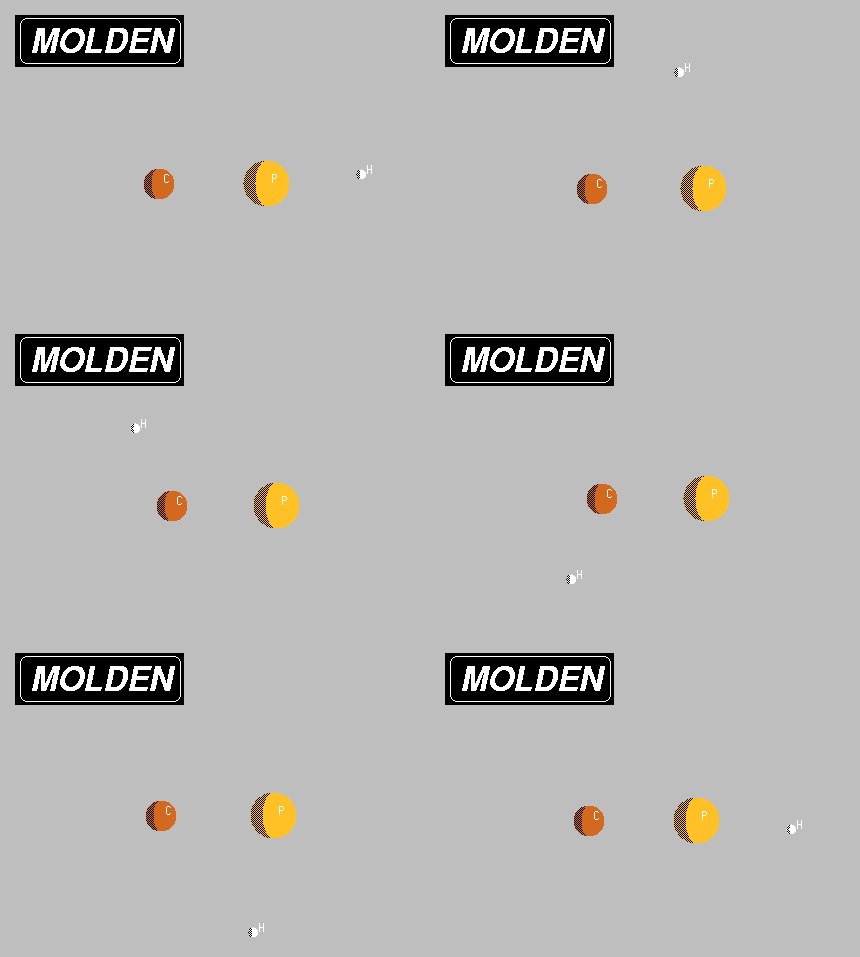
Animation: Eine Newton-Trajektorie im Konfigurationsraum des HCP Moleküls.
Die Geschwindigkeitsschwankungen resultieren aus der Anzahl der berechneten Wegpunkte.
Ein Bereich mit weniger Wegpunkten wird in der Animation schneller durchlaufen.
(erste Gestaltung: M. Hirsch)
Stand: Juli 2012,
Comments to (E-Mail)
|